

In the realm of modern communication, SIP Video Intercom systems have emerged as a revolutionary solution, seamlessly integrating voice and video to enhance security, convenience, and connectivity. As a dedicated SIP Video Intercom supplier, we understand the critical role that bandwidth plays in ensuring the optimal performance of these systems. In this blog post, we will delve into the intricacies of bandwidth requirements for SIP Video Intercom, exploring the factors that influence them and providing practical guidelines to help you make informed decisions.
Understanding SIP Video Intercom
Before we dive into the bandwidth requirements, let's briefly recap what SIP Video Intercom is. SIP, or Session Initiation Protocol, is a signaling protocol used for initiating, maintaining, and terminating real - time sessions that involve video, voice, messaging, and other communications applications. A SIP Video Intercom system allows users to have face - to - face conversations, typically at entrances or access points, using SIP - enabled devices. These systems are widely used in residential buildings, commercial complexes, and industrial facilities for security and access control purposes.
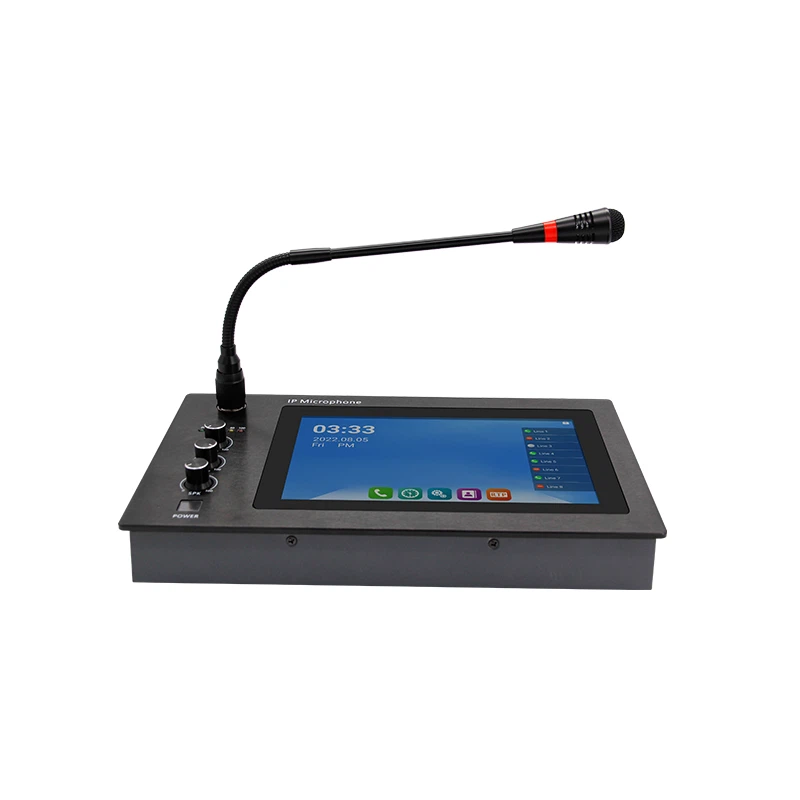
The SIP Video Intercom we supply is designed with high - quality components such as the Intercom Speaker Microphone and SIP Microphone to ensure clear audio and video transmission. However, without sufficient bandwidth, the quality of these transmissions can be severely compromised.
Factors Influencing Bandwidth Requirements
Video Resolution
One of the most significant factors affecting the bandwidth requirements of a SIP Video Intercom system is the video resolution. Higher resolutions require more data to be transmitted per frame, thus demanding greater bandwidth. For example:
- Standard Definition (SD): SD video typically has a resolution of 640x480 pixels. A SIP Video Intercom operating at SD resolution may require a bandwidth of around 512 Kbps to 1 Mbps. This is suitable for applications where high - definition visuals are not critical, or where bandwidth is limited.
- High Definition (HD): HD video offers a resolution of 1280x720 (720p) or 1920x1080 (1080p). A 720p SIP Video Intercom may need a bandwidth of 1.5 Mbps to 3 Mbps, while a 1080p system can require 3 Mbps to 6 Mbps. HD resolution provides sharper and more detailed images, which is beneficial for security applications where facial recognition or object identification is important.
- Ultra - High Definition (UHD): UHD, also known as 4K, has a resolution of 3840x2160 pixels. SIP Video Intercom systems operating at 4K resolution can demand bandwidths of 12 Mbps or more. While 4K offers unparalleled visual clarity, it also requires a robust and high - speed network infrastructure.
Frame Rate
The frame rate, measured in frames per second (fps), indicates how many individual frames are displayed in one second. A higher frame rate results in smoother video playback but also increases the bandwidth requirements. Common frame rates for SIP Video Intercom systems are 15 fps, 25 fps, and 30 fps.
- A system running at 15 fps may use approximately 30 - 50% less bandwidth compared to a system running at 30 fps with the same resolution. For applications where smooth motion is not a top priority, such as a static view of an entrance, a lower frame rate can be sufficient. However, for dynamic scenes or situations where quick movements need to be captured, a higher frame rate is recommended.
Audio Quality
In addition to video, the audio component of a SIP Video Intercom system also consumes bandwidth. The audio codec used and the number of audio channels can impact the bandwidth requirements.

- Codec: Different audio codecs have different compression ratios and bit rates. For example, the G.711 codec, which is uncompressed, has a bit rate of 64 Kbps per channel. On the other hand, the G.729 codec, which is highly compressed, has a bit rate of 8 Kbps per channel.
- Channels: Mono audio uses one channel, while stereo audio uses two channels. Naturally, stereo audio will require approximately twice the bandwidth of mono audio for the same codec.
Network Overhead
When data is transmitted over a network, there is additional overhead due to network protocols. This includes headers and other control information that are necessary for the proper functioning of the network. The network overhead can vary depending on the network infrastructure and the protocols used. Typically, it can add an extra 10 - 20% to the total bandwidth requirements of the SIP Video Intercom system.

Calculating Bandwidth Requirements
To calculate the approximate bandwidth requirements for a SIP Video Intercom system, you need to consider the factors mentioned above. Here is a simple formula:
Bandwidth (Total) = Bandwidth (Video) + Bandwidth (Audio)+ Bandwidth (Overhead)

Let's take an example of a SIP Video Intercom system with the following specifications:
- Video Resolution: 1080p
- Frame Rate: 30 fps
- Audio Codec: G.711 (Mono)
- Network Overhead: 15%
For the video component, a 1080p video at 30 fps may require approximately 4 Mbps. The audio component, using the G.711 codec in mono, will need 64 Kbps or 0.064 Mbps.
The total bandwidth before considering overhead is 4 Mbps+ 0.064 Mbps = 4.064 Mbps.
To account for the 15% network overhead, we calculate 15% of 4.064 Mbps, which is 0.6096 Mbps.
The total bandwidth requirement for this SIP Video Intercom system is 4.064 Mbps+ 0.6096 Mbps = 4.6736 Mbps.
Meeting Bandwidth Requirements
Once you have calculated the bandwidth requirements for your SIP Video Intercom system, you need to ensure that your network infrastructure can support it. Here are some steps you can take:
- Upgrade Your Internet Connection: If your current internet connection does not provide sufficient bandwidth, consider upgrading to a higher - speed plan. Many internet service providers offer a range of plans with different bandwidth capacities.
- Optimize Your Network: Use a wired network connection whenever possible, as it generally provides more stable and higher - speed connectivity compared to Wi - Fi. Additionally, ensure that your network equipment, such as routers and switches, is up - to - date and capable of handling the required traffic.
- Manage Network Traffic: Implement Quality of Service (QoS) settings on your network devices. QoS allows you to prioritize the traffic of your SIP Video Intercom system over other less critical traffic, ensuring that it gets the necessary bandwidth even during periods of high network usage.
Conclusion
Bandwidth is a crucial factor in the performance of SIP Video Intercom systems. By understanding the factors that influence bandwidth requirements and taking appropriate measures to meet them, you can ensure that your SIP Video Intercom system provides clear, reliable, and high - quality audio and video communication.
As a leading SIP Video Intercom supplier, we are committed to providing you with the best products and support. If you are interested in purchasing our SIP Video Intercom systems or have any questions regarding bandwidth requirements or network optimization, please do not hesitate to contact us for a procurement discussion. We look forward to helping you enhance your communication and security solutions.
References
- Cisco Systems. "Bandwidth Requirements for Video Applications." Cisco White Paper.
- ITU - T Recommendations on Audio and Video Codecs.
- IETF RFCs related to SIP and network protocols.