


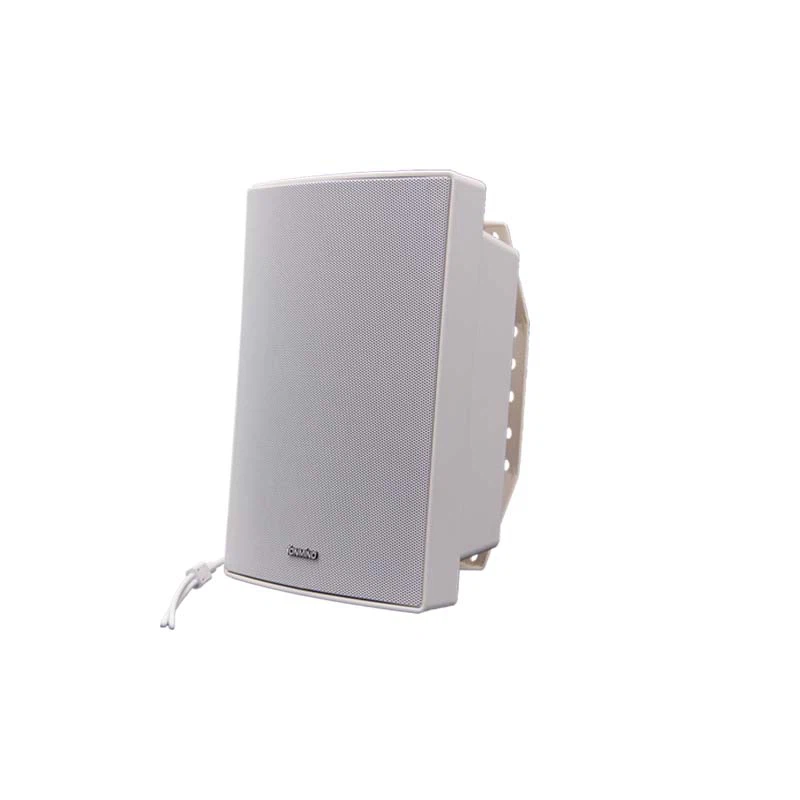
Wall Mount Speaker
TONMIND focuses on network audio technology. Through continuous technological innovation, Tonmind has been exploring improvements and breakthroughs in product performance, committed to supplying cost-effective, consistent, and reliable IP audio solutions to customers.
Why Choose Us
Customer Satisfaction
Providing after-sales services can enhance customer satisfaction by ensuring that customers' needs are met even after the purchase. This can lead to increased customer loyalty and positive word-of-mouth referrals.
Quality control
In the processing of production, our professional technical engineers inspect the processing to ensure the quality of products,After our machine finish , our engineer will make 24 hours test constantly and ensure the machine reach to the best performance.
One-stop Solution
With rich experience and one-to-one service,we can help you choose products and answer technical questions.
Custom Service
We offer OEM/ODM customization services that allow customers to make tailored requests for our software and audio products. This flexibility ensures that you get the best products suited for your specific applications.


Wall mounted Speaker refers to any speaker that can be mounted to the surface of a wall or ceiling. There are various types and sizes available and can be used for home audio systems or large commercial installations.
Benefits of Wall Mount Speaker
Looks Great
Wall mounting a soundbar is one of the most popular ways to make your TV entertainment system look clean and sleek. The horizontal structure of the soundbar and its thin profile allows the overall setup to look very modern.
No Clutter
Wall-mounted soundbars force you to organize your wires to achieve a sleek and modern look. It means no more nests of cables on top of the entertainment cabinet, or worse, the floor.
Save Space
Some soundbars are quite big, so if you have a small living room, wall mounting can help reduce the clutter in your living room.
Reduces Sound Leakage
A wall-mounted soundbar will block the sound from escaping out of the sides, which can be helpful if you live in an apartment building with thin walls. It will also help reduce sound leakage for the people surrounding you.
Provides Full Sound Range
A wall-mounted soundbar provides full-range sounds that can be better calibrated to your room. It means that you can create a more immersive sound experience.
Aesthetics & Space
- Both in-wall and wall-mounted speakers offer a more discreet, space-saving design compared to bookshelf and similar speakers. On-wall speakers are considerably slimmer than traditional speakers and are made to hang directly on a wall like a painting or a photograph, taking up less visual and functional space.
- In-wall speakers are installed directly into your walls without a speaker cabinet and thus provide an even more integrated, modern look, though with more installation time and cost. In-wall speakers have the edge somewhat here. You may also want to check out the best in-ceiling speaker if you like the in-wall look.
Sound Quality
- In-wall and on-wall speakers both tend to be higher-end pieces of audio equipment designed for more demanding audio enthusiasts (though not necessarily audiophiles).the bass response can sometimes suffer because they’re installed directly into your wall, making them sound a little thinner than wall-mounted models.
- Most offer adjustable woofers so that users can calibrate their position for optimal bass response, but this basic design feature means on-wall models come out ahead a bit.
Cost
Both options tend to start at slightly higher price points than comparable traditional speakers, but in-wall speakers require a custom installation. This fact can add considerably to their overall cost.

Where to wall mount speakers
Center speakers
Center speakers are popular wall mount speakers. Since this speaker needs to be placed between the two front speakers and near the screen, wall mounting the center above or below the TV is a popular option. Note however that if the center is placed below the screen, it should be at least 40 cm above the floor.
Front speakers
If the front speakers are stereo towers, these can simply rest on the floor on either side of the television.systems that employ smaller satellites will have to place them on speaker stands, a shelf or wall mount them. Wall mounting is often the easiest option. It’s important that the speakers be placed at ear height and that they be placed equidistant on either side of the TV.there should be at least one meter of space between the speakers and any side walls.
Surround speakers
While larger stereo speakers are often used as front speakers, the surround speakers in a home cinema system are usually compact. This makes them ideal wall mount speakers. Surround speakers should be ideally placed 1.40 meters above the floor. This applies to direct radiating speakers as well as dipoles.
The answer to this question depends on the room, just as much as on the speaker itself, meaning that you will have to experiment a little bit in order to get it right. Let's first discuss what impact a back wall can have on the performance of your speakers.
When you put a speaker close to the wall, the bass frequencies become more exaggerated. This is because the bass frequencies are dispersed from the loudspeaker in all directions – including backwards – much like a sphere. The higher frequencies, only travel forward.
If you put the speaker closer to the wall, you're going to increase the reflections of the low frequencies from the back of the speaker. So, in terms of proximity to the wall, a balance has to be struck between having too much or too little emphasis on the low frequencies. This is what we meant by the need to experiment.
What is generally recommended is to start by putting the speakers very close to the rear wall, which is very unlikely to give the best results. Then, you can gradually start moving the speakers out from the wall, all the while listening to music that has some clearly decipherable and tuneful bass, and then stop at the point where the bass sounds best.
As you move gradually outwards, you should be able to hear that the low end becomes more and more defined and that it's increasingly easy to follow the bass notes. The trick is to keep increasing the distance of the speakers from the wall until you get to the point where the bass starts to sound worse, if not completely missing from the music altogether.you'll want to start going back towards the wall again, little by little, until you reach the optimal spot.
There exists some theoretical approaches to the distance between the speaker and the wall, including something called SBIR, which is Speaker Boundary Interference Response. What that means is that the sound coming from the back of the speaker hits the rear wall and is then reflected back into the room. That sound is,slightly delayed compared to the direct sound coming from the speaker and, on its way back into the room, it gets mixed with the sound coming directly from the speaker. Depending on the wavelength and the frequency of that reflected sound, it could actually end up cancelling out some of the direct sound from the speaker, i.e some of the sound as you perceive it from your listening position will actually be missing.
The distance between the speakers and the rear wall can directly determine which of these frequencies are affected and how much they're affected, and that's the main reasons that it's so important to have the correct distance to the rear wall. As we mentioned earler, this can be calculated but, in reality, it's more efficient in the real world to do it by ear in the way that we have described here. If nothing else this is because theory and reality don't always correspond, and others factors such as the distance to the sidewalls, floors, and ceilings also have their part to play.
Clean them before storing: One of the most recommended practices to protect your speakers is to clean them properly before storing them.
Removing dust and debris before storing them will ensure that the internals of your speaker aren’t prone to dust damage. Skipping this step can potentially impact the overall sound quality and render them unusable as well.
Take care of the cables: Just like the speaker, the bundled wires are equally important. You need to fold them properly without twisting them, which could result in some damage. Use a plastic zipper bag to store them. These are best to keep the air and moisture out that might damage the outer cover of the wire and make them usable.
Find an appropriate place: Finding a safe place to store your speakers is greatly important if not the most important thing. Storing any electronics in a dry and cool place is recommended and your speakers aren’t any different. As a rule of thumb, the place should meet three criteria, it should be dust-free, away from the reach of kids and lets, and not in direct sunlight. And this goes without saying that it needs to be dry.
Use the right bag: Another crucial step in storing your speakers properly is to keep them in the correct box. It is recommended that you first put your speakers in the protective bag given by the manufacturer. In case you don’t have them, you can order them online. These are relatively inexpensive.you need to put your speakers back in their original box.
Periodically check on them: Your job is not over after you have stored them. Even when not in regular use, you should have a regular routine to check up on it on a periodical basis. This will make sure that you can factor in any accidental damages your speakers might be prone to. During these periodical check-ups, you can also clean the box to get rid of dust and debris accumulation.
The Best Way To Hang Speakers On A Wall
Make marks on your wall
‘Take a mounting bracket’ and ‘place it against the wall’ . Then ‘take a sharpie or a pen’ and make a marking at the top hole and the bottom hole at the location of the wall that you will drill.
Drill the holes
A 3/8-inch drill bit is recommended to make the drills. ‘Drill the bottom hole and top hole’ at the exact location of the wall where you made the marks. ‘Take a Philips driving bit’ and attach it to the screw gun. For easier installation, ‘remove the hanging bracket’ from your speaker.
Fasten your brackets into the wall
Put the bracket on your wall’ and align the pre-drilled pits with the coinciding marks. Slip your screw fasteners' tapered tips across the bracket base and the holes. ‘Thread your fasteners into the wall’ using the screw gun.
Attach your speakers to the wall
Hold your bracket firmly with your hand and ‘drag it downwards to ensure that it will hold the speakers’ . Take your speaker and attach them to the bracket.
Our Factory
XIAMEN TONMIND TECHNOLOGY CO., LTD (TONMIND) is a high-tech company specializing in network audio and IP PA solutions since 2014. With an R&D center in Xiamen Software Center, over 50% of the office staff are professional engineers. TONMIND is dedicated to delivering top-quality IP SIP speakers, IP ONVIF speakers, IP paging microphones, IP PA software, and IP intercom systems with broad applications across various sectors such as schools, retail, malls, commercial buildings, offices, hotels, and hospitals.

Certifications

FAQ
As one of the leading wall mount speaker manufacturers and suppliers in China, we warmly welcome you to wholesale high-grade wall mount speaker from our factory. All customized products are with high quality and competitive price.
boxes for wall mount speaker, wall mount speaker configuration, wall mount speaker housings