


Column Loudspeaker
TONMIND focuses on network audio technology. Through continuous technological innovation, Tonmind has been exploring improvements and breakthroughs in product performance, committed to supplying cost-effective, consistent, and reliable IP audio solutions to customers.
Why Choose Us
Customer Satisfaction
Providing after-sales services can enhance customer satisfaction by ensuring that customers' needs are met even after the purchase. This can lead to increased customer loyalty and positive word-of-mouth referrals.
Quality control
In the processing of production, our professional technical engineers inspect the processing to ensure the quality of products,After our machine finish , our engineer will make 24 hours test constantly and ensure the machine reach to the best performance.
One-stop Solution
With rich experience and one-to-one service,we can help you choose products and answer technical questions.
Custom Service
We offer OEM/ODM customization services that allow customers to make tailored requests for our software and audio products. This flexibility ensures that you get the best products suited for your specific applications.


Similar to full-sized line arrays, column speakers are able to produce consistent sound levels from the front to the back of the listening room, without having to use bulky multiple speaker cabinets.
Benefits of Column Loudspeaker
Looks do matter (Aesthetics): If the aesthetics of the speaker is a concern to you, a column speaker can be the best choice for you. With its sleek design, it can blend well with its surroundings, especially at traditional churches where the visual impact of a speaker should be kept at bay.
Maximum coverage: Passive column speakers, especially passive ones can provide excellent pattern control. With the advancements in technology, the new era column speakers can provide an extended bass response. Some of them even allow users to adjust coverage patterns to match the shape of the listening space. These are more apt for outdoor applications. Powered column speakers adjust coverage electronically mostly from a remote computer. Powered speakers can provide you with ‘steered aiming’ and ‘shaped aiming’. Steered aiming just adjusts the direction of the coverage whereas shaped aiming provides high speech intelligibility even at complicated architectural configurations such as balconies and multiple raked seating planes.
Consistent sound quality: Column speakers offer consistency in sound quality from front to back of the listening space.
Cost effective: Though column speakers have multiple drivers, they all are enclosed in a single cabinet.column speakers are much cheaper compared to vertical line array speakers. Passive column speakers house very few amplifier channels and powered speakers have built-in amplifiers. This reduces the cost of the column speakers to a great extent.
Real World Gear: Column Loudspeakers


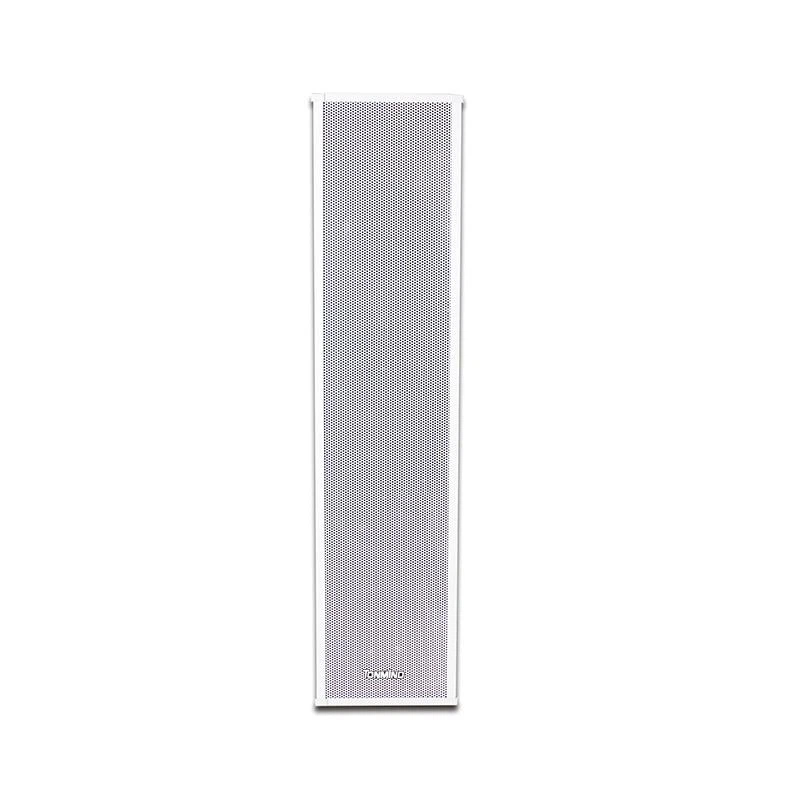
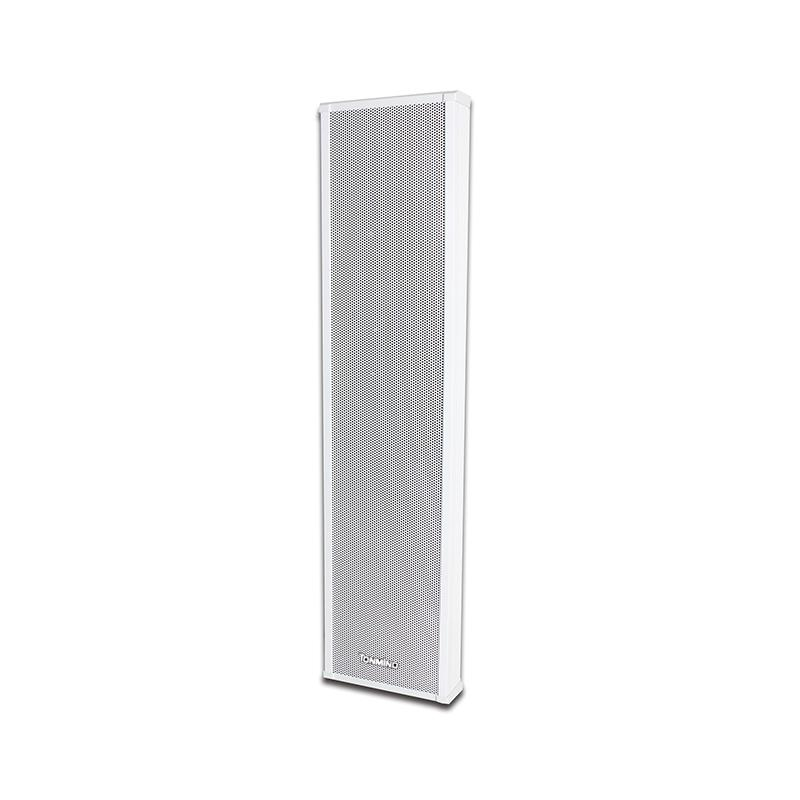
Line source (column) loudspeakers have been around for well over a half century, but they’ve gained in popularity over the past decade because they offer a solution for applications calling for efficiency combined with even coverage from a very slim, unobtrusive physical profile.
The characteristics of line source loudspeakers – wide horizontal coverage, minimal vertical coverage above and below the enclosure and coherent sound in the vocal range – are all attractive features, particularly in highly reverberant environments. Driver spacing determines the highest frequency at which a column of identical drivers acts as a line source, while the length of the column determines the directivity of the lowest frequencies.
Column loudspeakers with 6.5-inch diameter cones, when tightly spaced, will couple up to about 1,000 Hz. Four-inch cones couple to about 1,600 Hz, and 2-inch cones to 3,300 Hz. Above these frequencies, lobes appear in the polar response;restricting the high-frequency response of some of the cones can reduce lobing. This can be achieved with passive filters in the cabinet or with active filters.
It’s common for columns to be combined as multiple cabinets to achieve better performance as taller systems for bigger rooms. Longer columns provide pattern control reaching to lower frequencies.
A specialized version of the line source column is called “digitally steerable,” with individual amplification, delay and equalization for each driver, allowing the column’s vertical coverage to be tilted down (or up) and focused for short or long throws.
Applications requiring additional bandwidth and dynamic range have led to 2-way designs that incorporate separate high-frequency transducers in addition to the column of tightly spaced loudspeaker cones. Some systems have companion LF columns that employ long-excursion small-format woofers to extend pattern control to lower frequencies.traditional subwoofers can supplement a column’s LF response.
Some models are expressly designed for portable applications, usually paired with compact subwoofers.we’ve seen more columns packaged with dedicated subs that house amplification and DSP as well as providing a base for mounting into one cohesive unit.
Column speakers are generally used in some special places, such as background music in shopping malls, campus broadcasts in schools, gymnasiums and concerts, etc. They are all large occasions. Many units of the same size are used to improve the sound in the effective frequency band. Designed for pressure rating.what is the difference between column speaker and our ordinary speakers.
The sound column is a combination of multiple speakers connected in phase. The direction characteristic of the sound column is similar to that of a single speaker in the horizontal direction, but it is greatly improved in the vertical direction. It propagates in a wave pattern in the horizontal direction, but has a strong directivity characteristic in the vertical direction, forming a "plate"-like three-dimensional radiation effect.
Install the sound column near the stage entrance and point this "sound plate" towards the audience. The sound beam radiates to the back row of the auditorium with strong sound energy, while the front row is mutually affected by the phase difference caused by the different vertical distances of the speakers. Attenuation, the sound pressure may be lower than that of a single speaker, which makes the direct sound distribution of the sound field tend to be even. The horizontal direction of the sound column should not be "bunched", and there should be a large horizontal radiation angle, so that the sound field can be more uniform in the left and right directions.
Column speaker usually refers to 4 to 10 cone speakers arranged in a line. The feature is that when transmitting sound in the horizontal direction, the radiation angle of the speaker is the same as that of a speaker, while when transmitting sound in the vertical direction, the radiation angle of the speaker increases with the combination of speakers, especially when high-frequency sound , The sound beam can be transmitted in a certain direction.
The sound column speaker has a very effective vertical control effect. In an environment where the reverberation situation is more serious, the column speaker can effectively concentrate the sound to the listener, reducing the occurrence of rebound after reaching the wall.
The characteristic of the sound column is that it has a strong directivity in the vertical direction. The longer the sound column, the narrower the sound beam, the more concentrated the energy, and the stronger the directivity. When the length of the sound column is fixed, the higher the frequency, the narrower the sound beam and the stronger the directivity.
The best column speakers can be formed into multiple specifications according to different structures. The smaller the area of the "sound plate", the stronger the bunching effect, the sharper the directivity, and the on-axis sensitivity is much higher than that of a single speaker.
The sound axis efficiency of the sound column on the main shaft is higher than that of a single speaker.the more speakers that make up the sound column, the higher the sensitivity on the main axis and the farther the sound radiation distance.
Reasonable control of the suspension height and depression angle of the sound column can make the sound field more uniform and clear. Since the total rated power of the sound column is several times that of a single speaker, and the focusing effect in the direction of the sound axis, the sensitivity is doubled, which is more effective for long-distance sound reinforcement.
Compared with a single speaker, the low-frequency radiation efficiency of the sound column is greatly improved, thereby increasing the low-frequency response and enriching the tone. Using the directional characteristics of the sound column, placing the microphone outside the main sound beam (that is, the lightest sound in the up and down directions at both ends of the sound column), at the position with the weakest sound pressure, can improve the howling phenomenon and increase the sound transmission gain. In places where the reverberation time is long, the use of the sound column can greatly improve the clarity of the sound.
The directivity of the sound column weakens as the frequency decreases, that is, the directivity at low frequencies is very poor. Therefore, the vertical directivity of the sound column should be improved, that is, the directivity at high frequencies is weakened, and the directivity at low frequencies is increased. Usually, the sound column can be divided into high and low frequency bands and connected to a crossover network to make the long sound column emit low frequency sound, and the short sound column emit high frequency sound to improve its frequency response. Or use some common methods in important venues to separate the sound with a high-frequency horn speaker in the frequency band above 1KHz to improve high-frequency directivity and high-frequency sound.
In addition to the defects in the vertical directivity of the sound column that need to be improved by the above methods, the horizontal directivity also exists.
These problems can be solved with the help of a tone controller or equalizer. Lowering the volume of the bass frequency helps the speech sound to be clear, but it has a negative impact on music reproduction.
The installation angle of each speaker on a single speaker can also be based on the principle of sound wave diffraction, and the speaker hole on the sound column panel can be opened into a rectangular slit to improve the horizontal direction of the high frequency band.
The sound column, as an important speaker device, is still widely used in many occasions.
9 Tips how to maintain your loudspeaker
The loudspeaker must be fully charged and stored if the speaker box is not in use for a long time.
You must fully charge before using and after. Please charge the loudspeaker immediately when the speaker indicates that the power supply is low. The battery can easily be damaged when the battery is running out of power.
The normal working temperature of outdoor audio equipment should be 18 ℃ ~ 45 ℃. If the temperature is too low, it will reduce the sensitivity of the speaker; if it is too high, it is easy to burn out the components or make the components aging earlier.
Please pay special attention to cooling and maintaining good ventilation in summer.
Avoid being close to heat sources, such as heaters, open fires, etc.
In case of rainy days, the outdoor audio surface should not be drenched by Rain Water. Dry it with a towel as soon as it gets wet, and try not to expose it directly to the sun.
Reset the function keys after the outdoor speakers are used up.
If the function key is not reset for a long time, and the pull button spring will be in a state of force for a long time, it is easy to cause dysfunction.
When the speaker box is not in use, it must be recharged once a month, especially in winter, otherwise, the battery is easy to damage.
Turning the volume potentiometer of the loudspeaker to a minimum before switching on and off the audio power supply is one of the most effective protection measures for amplifiers and speakers. At this time, the power amplification of the power amplifier is almost zero, at least in the case of misoperation, it will not cause harm to the speaker.
The speaker should be commonly used, especially in the humid and high-temperature season when it is not in use for a long time, it is best to turn on the speaker for half an hour every day.
Our Factory
XIAMEN TONMIND TECHNOLOGY CO., LTD (TONMIND) is a high-tech company specializing in network audio and IP PA solutions since 2014. With an R&D center in Xiamen Software Center, over 50% of the office staff are professional engineers. TONMIND is dedicated to delivering top-quality IP SIP speakers, IP ONVIF speakers, IP paging microphones, IP PA software, and IP intercom systems with broad applications across various sectors such as schools, retail, malls, commercial buildings, offices, hotels, and hospitals.

Certifications

FAQ
As one of the leading column loudspeaker manufacturers and suppliers in China, we warmly welcome you to wholesale high-grade column loudspeaker from our factory. All customized products are with high quality and competitive price.
club column loudspeaker, factory column loudspeaker, gorge column loudspeaker